Children growing in poetry (2026)
A book of songs for children and adults, with drawings.
Capìtulu — L'Opere
The published collection and the projects in preparation.
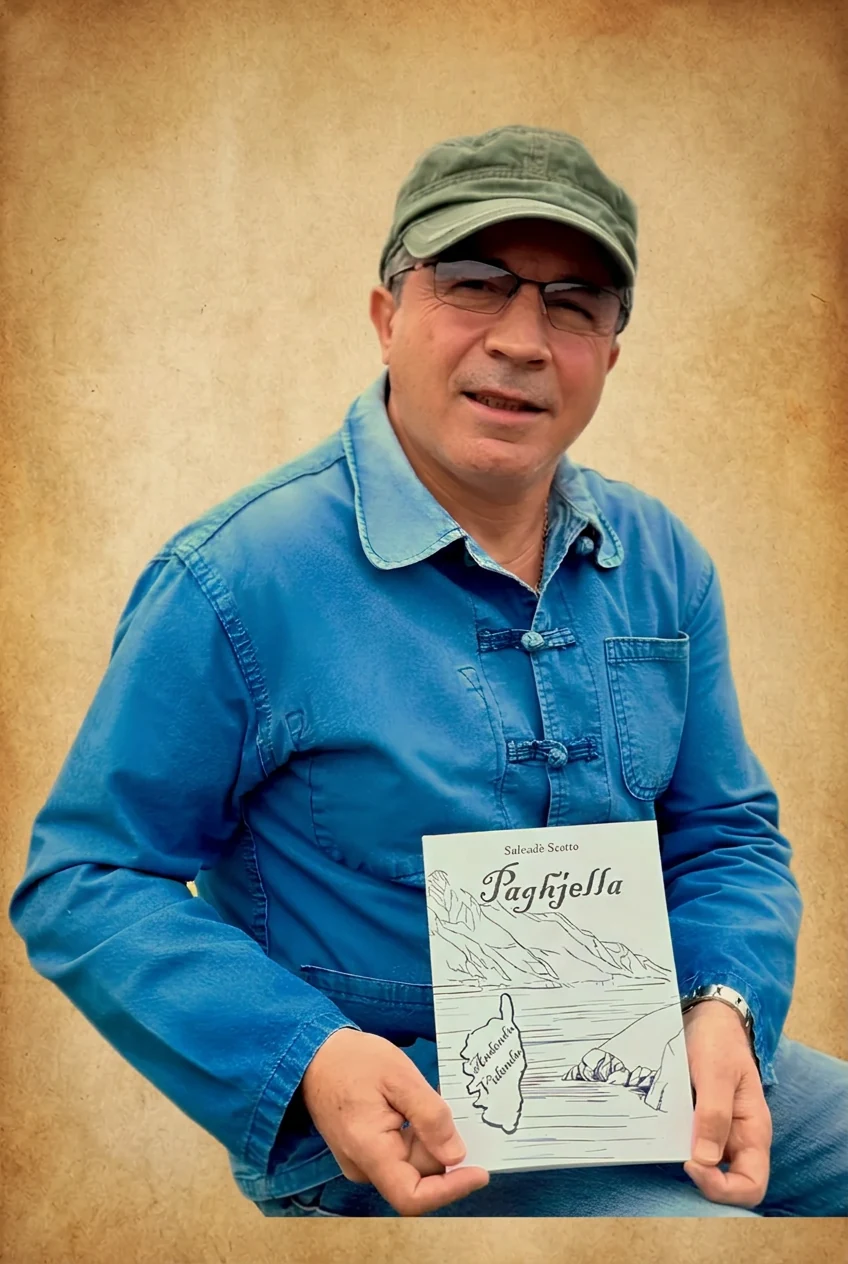
Éditions Salvadò Scotto, Ajaccio, 2024 — 74 pages, 35 paghjelles
Andendu Videndu — “walking, watching” — gathers paghjelles written along paths, villages and seasons.
The complete book runs to 74 pages and brings together 35 paghjelles, with drawings and pages calligraphed by the poet's own hand.
The texts are in Corsican, in the traditional paghjella form: short verses made for the voice, where nature, memory and the people of the island come first.
Titles in the collection include Paghjella Bella, Paghjella Renosu, Paghjella Niolu, Paghjella Pescadore and Paghjella u Prunelli.
The collection speaks to readers of Corsican poetry as much as to those discovering the tradition.
Extract
À mezi monti ed ellu
Lu to versu cusì bellu
Cant'è paghjelle bell'onde
À li so chjam'è risponde
Da Basterga chi ghjuvelli
À li paesi Prunelli
Translation
Among the mountains, and he,
your verse, so beautiful,
sings paghjelles, fine waves,
answering their calls,
from Bastelica, what jewels,
to the villages of the Prunelli.
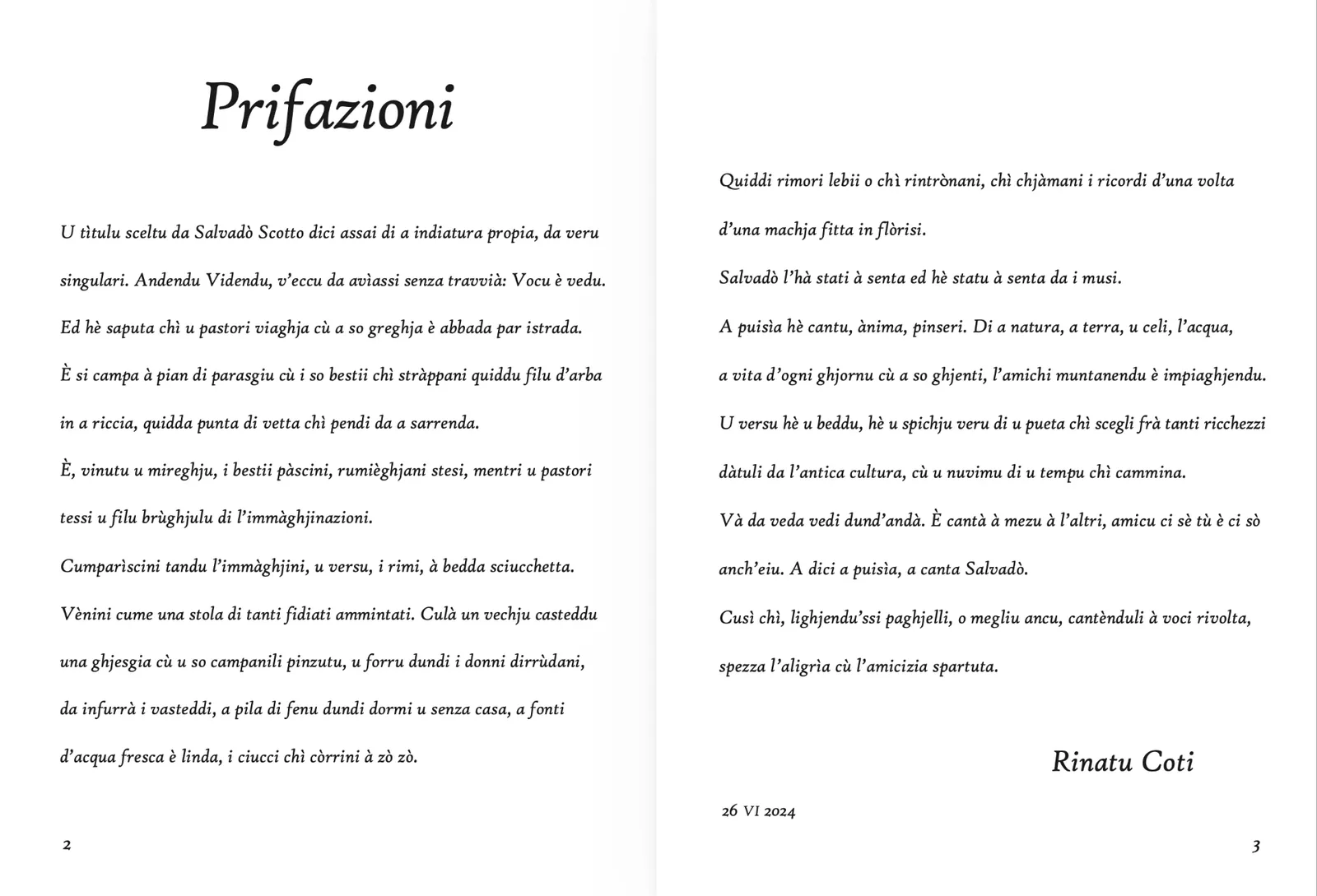
Prifazioni
The preface to the collection, written in Corsican by the writer Rinatu Coti.
The title chosen by Salvadò Scotto says much about his own singular way of being. Andendu Videndu — “walking, seeing” — here you are on the way, without detour: I walk and I see.
And it is known that the shepherd travels with his flock and watches over the road. He lives to the rhythm of the slopes, with his animals pulling that thread of grass from the scrub, that ridge hanging above the hillside.
And when midday comes, the animals graze, then lie down and chew, while the shepherd weaves the dark thread of imagination.
Then the images appear, the verse, the rhymes, gently. They come like a procession of remembered things. Over there an old castle, a church with its pointed bell tower, the oven where the women knead the bread, the haystack where the homeless man sleeps, the fountain of fresh clear water, the children running here and there.
Those light sounds, or those that echo, calling up memories of long ago, of dense maquis in flower. Salvadò listened to them, and the muses listened to him.
Poetry is song, soul, thought. Of nature, of the earth, the sky, the water, of daily life with its people and friends, from the mountain to the plain.
The verse is the beautiful, the true mirror of the poet who chooses among the many riches handed down by the old culture, together with the newness of passing time.
He goes to see where to go. And he sings among the others; friend, you are there, and so am I. Salvadò speaks poetry, he sings it.
So, reading these paghjelles, or better still singing them out loud, share the joy through shared friendship.
U tìtulu sceltu da Salvadò Scotto dici assai di a indiatura propia, da veru singulari. Andendu Videndu, v'eccu da avìassi senza travvià : Vocu è vedu.
Ed hè saputa chì u pastori viaghja cù a so greghja è abbada par istrada. È si campa à pian di parasgiu cù i so bestii chì stràppani quiddu filu d'arba in a riccia, quidda punta di vetta chì pendi da a sarrenda.
È, vinutu u mireghju, i bestii pàscini, rumièghjani stesi, mentri u pastori tessi u filu brùghjulu di l'immàghjinazioni.
Cumparìscini tandu l'immàghjini, u versu, i rimi, à bedda sciucchetta. Vènini cume una stola di tanti fidiati ammintati. Culà un vechju casteddu, una ghjesgia cù u so campanili pinzutu, u forru dundi i donni dirrùdani da infurrà i vasteddi, a pila di fenu dundi dormi u senza casa, a fonti d'acqua fresca è linda, i ciucci chì còrrini à zò zò.
Quiddi rimori lebii o chì rintrònani, chì chjàmani i ricordi d'una volta d'una machja fitta in flòrisi. Salvadò l'hà stati à senta ed hè statu à senta da i musi.
A puisìa hè cantu, ànima, pinseri. Di a natura, a terra, u celi, l'acqua, a vita d'ogni ghjornu cù a so ghjenti, l'amichi muntanendu è impiaghjendu.
U versu hè u beddu, hè u spichju veru di u pueta chì scegli frà tanti ricchezzi dàtuli da l'antica cultura, cù u nuvimu di u tempu chì cammina.
Và da veda vedi dund'andà. È cantà à mezu à l'altri, amicu ci sè tù è ci sò anch'eiu. A dici a puisìa, a canta Salvadò.
Cusì chì, lighjendu'ssi paghjelli, o megliu ancu, cantènduli à voci rivolta, spezza l'aligrìa cù l'amicizia spartuta.
Rinatu Coti — 26 VI 2024
Ten paghjelles from the book
A selection of ten titles chosen by Salvadò Scotto, among the 35 paghjelles in the book.
The full texts are found in the collection: 74 pages of poems, drawings and calligraphy.
Coming next
A book of songs for children and adults, with drawings.
A collection on a USB key with QR codes.